Quick Comparison Table
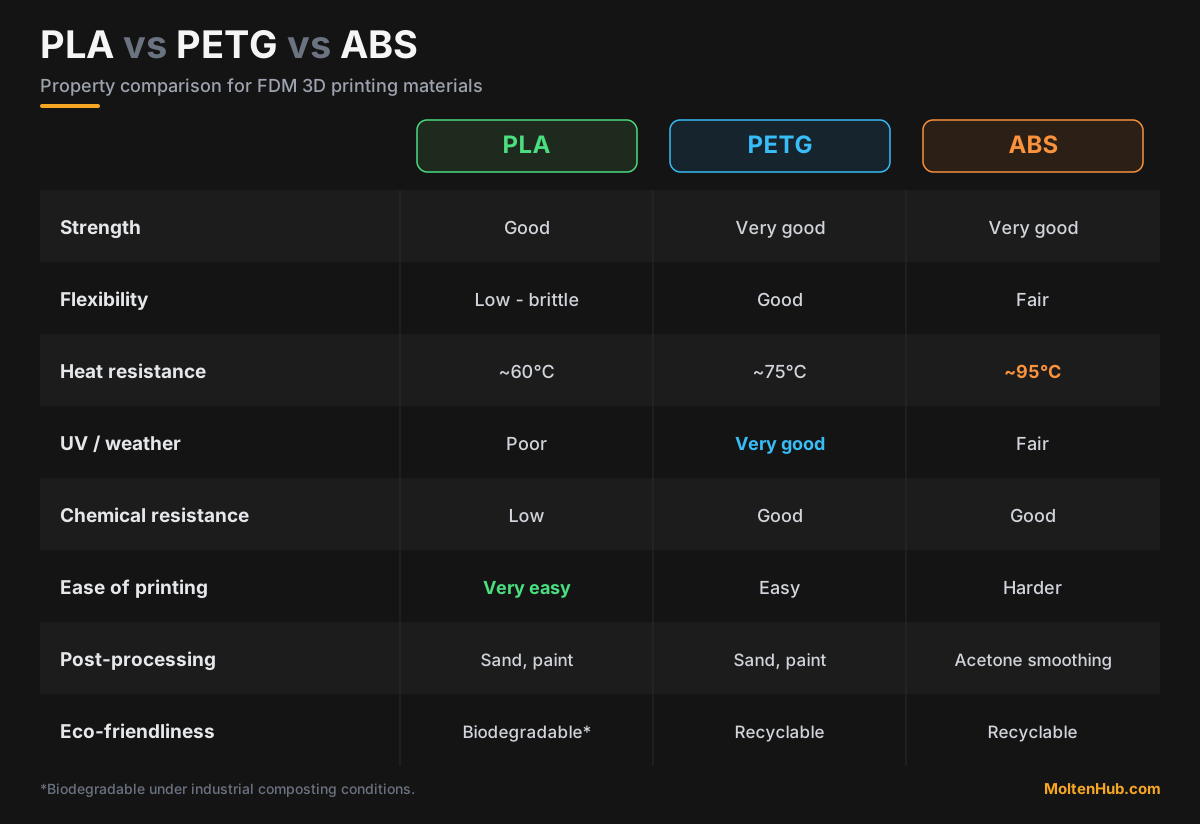
Before we dive into details, here's a summary of the key properties:
PLA - Best for Prototypes and Decorative Items
PLA (Polylactic Acid) is by far the most popular 3D printing material in the world. It's derived from renewable resources like cornstarch, making it the most eco-friendly option among standard filaments.
Its greatest advantage is ease of printing. PLA doesn't require a heated bed, exhibits minimal warping, and rarely causes adhesion problems. It produces prints with excellent surface quality and sharp details.
When to choose PLA: It's ideal for visual prototypes and presentation models, decorative items like vases, planters, and ornaments, larger display figurines where ultra-fine detail isn't critical, school and university projects, and anything that won't face high temperatures or heavy mechanical loads. For small, highly detailed figurines and collectible miniatures, resin (SLA) is usually the better choice.
When to avoid PLA: Don't use PLA for parts exposed to temperatures above 55–60°C, such as inside a car on a hot day or near a heat source. Avoid PLA for impact-bearing parts - it's relatively brittle and tends to snap rather than flex. Outdoors, PLA will gradually degrade from UV exposure and moisture.
See the full properties on our PLA material page.
PETG - The Versatile All-Rounder
PETG (Polyethylene Terephthalate Glycol) bridges the gap between PLA and ABS, offering a balance of printability and durability. For many users, it's the most versatile filament available.
PETG excels at weather and UV resistance. Prints in PETG can safely be used outdoors where PLA would degrade over time. The material also resists many chemicals, making it a solid choice for containers and parts that contact chemical substances.
In terms of toughness, PETG is far less brittle than PLA. Instead of snapping, it deforms under load - which is desirable in many mechanical applications. It also handles higher temperatures than PLA, surviving up to around 75°C.
When to choose PETG: It's the best material for outdoor parts like mounts, enclosures, and brackets, mechanical components needing some flexibility, prints exposed to moisture or chemicals, storage containers, and anything where you need better durability than PLA while keeping printing straightforward.
When to avoid PETG: If you need ultra-fine detail, PLA may give a crisper result. If you need heat resistance above 80°C, ABS is the better bet.
See the full properties on our PETG material page.
ABS - The Industrial Classic
ABS (Acrylonitrile Butadiene Styrene) is the material LEGO bricks are made from - which tells you everything about its toughness. ABS has been used in the automotive, electronics, and appliance industries for decades.
Its standout feature is heat resistance, reaching approximately 95°C - significantly more than both PLA and PETG. ABS also delivers excellent impact resistance. Where PLA would crack, ABS bends and survives.
A unique characteristic of ABS is that it can be smoothed with acetone vapor. This process melts a thin layer on the print's surface, eliminating visible layer lines and producing a smooth, almost injection-molded finish. No other common filament offers such a simple post-processing method.
When to choose ABS: It's optimal for electronics enclosures exposed to heat, automotive components (under the hood, inside the cabin), parts that must withstand impacts, prints requiring a smooth finish via acetone smoothing, and industrial or engineering applications.
When to avoid ABS: ABS is harder to print than PLA and PETG. It requires a heated bed and an enclosed print chamber due to its tendency to warp and detach from the build plate. It also produces noticeable fumes during printing, requiring good ventilation. These issues don't affect you when ordering through a print-on-demand service - that's our job to handle.
See the full properties on our ABS material page.
Which Material Should You Choose? Practical Scenarios
To make the decision easier, here are some concrete scenarios:
A visual prototype for a presentation - go with PLA. Best surface quality, fast print, great detail reproduction.
An electronics enclosure for indoor use - go with PETG. Good strength, moisture resistant, easy to print.
A component under a car hood - go with ABS. Highest heat resistance among the three.
A tool holder for the garage - go with PETG. Tough, weather-resistant, solid for mechanical applications.
A collectible figurine - go with PLA, or consider resin printing for the finest possible detail.
An enclosure exposed to chemicals - go with PETG or ABS. Both offer good chemical resistance.
Not sure where to start? If you don't have specific requirements for temperature, mechanical strength, or outdoor use - start with PLA. It delivers great print quality and covers most decorative and prototyping needs. If testing reveals you need something tougher, you can re-order in PETG or ABS.
What About Other Materials?
PLA, PETG, and ABS are the three most common FDM materials, but far from the only options. At MoltenHub we also offer Nylon for industrial applications demanding peak strength and TPU for flexible rubber-like prints. For ultra-precise models with smooth surfaces, we offer Resin printed via SLA technology.
Compare all available materials on our materials page.
Check the Price in Every Material
The best way to compare costs is to upload your model and check the price across all materials. It takes just a few clicks - the quote is instant and free.
Upload Your Model & Compare Material Prices →
Read also:
Share this article